Antibacterial Activity of Selected Malaysian Honey
BACKGROUND:
Antibacterial activity of honey is mainly dependent on a
combination of its peroxide activity and non-peroxide components. This study
aims to investigate antibacterial activity of five varieties of Malaysian honey
(three monofloral; acacia, gelam and pineapple, and two polyfloral; kelulut and
tualang) against Staphylococcus aureus, Bacillus cereus, Escherichia coli, and
Pseudomonas aeruginosa.
METHODS:
Minimum Inhibitory Concentration (MIC) and Minimum
Bactericidal Concentration (MBC) were performed for semi-quantitative
evaluation. Agar well diffusion assay was used to investigate peroxide and
non-peroxide activities of honey.
RESULTS:
The results showed that gelam honey possessed lowest MIC
value against S. aureus with 5% (w/v) MIC and MBC of 6.25% (w/v). Highest MIC
values were shown by pineapple honey against E. coli and P. aeruginosa as well
as acacia honey against E. coli with 25% (w/v) MIC and 50% (w/v) MBC values.
Agar inhibition assay showed kelulut honey to possess highest total
antibacterial activity against S.aureus with 26.49 equivalent phenol
concentrations (EPC) and non-peroxide activity of 25.74 EPC. Lowest
antibacterial activity was observed in acacia honey against E. coli with total
activity of 7.85 EPC and non-peroxide activity of 7.59 EPC. There were no
significant differences (p > 0.05) between the total antibacterial
activities and non-peroxide activities of Malaysian honey. The intraspecific
correlation between MIC and EPC of E. coli (r = -0.8559 was high while that
between MIC and EPC of P. aeruginosa was observed to be moderate (r = -0.6469).
S. aureus recorded a smaller correlation towards the opposite direction (r =
0.5045). In contrast, B.cereus showed a very low intraspecific correlation
between MIC and EPC (r = -0.1482).
CONCLUSIONS:
Malaysian honey, namely gelam, kelulut and tualang, have
high antibacterial potency derived from total and non-peroxide activities,
which implies that both peroxide and other constituents are mutually important
as contributing factors to the antibacterial property of honey.
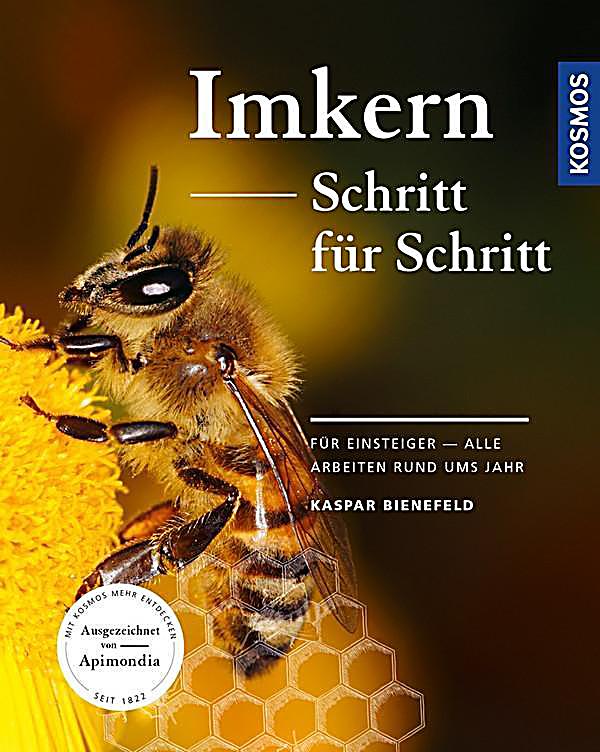 Bienefeld, Kaspar (2016): Imkern Schritt für Schritt: Für Einsteiger - alle Arbeiten rund ums Jahr
Weiterlesen ...
Bienefeld, Kaspar (2016): Imkern Schritt für Schritt: Für Einsteiger - alle Arbeiten rund ums Jahr
Weiterlesen ...